How behavior and body shape help identify waterfowl
Divers and Dabblers at Peace Valley Nature Center
How behavior and body shape help identify waterfowl
If you’ve ever stood along the shores of Lake Galena at Peace Valley Nature Center and watched ducks feeding, you’ve probably noticed two very different styles.
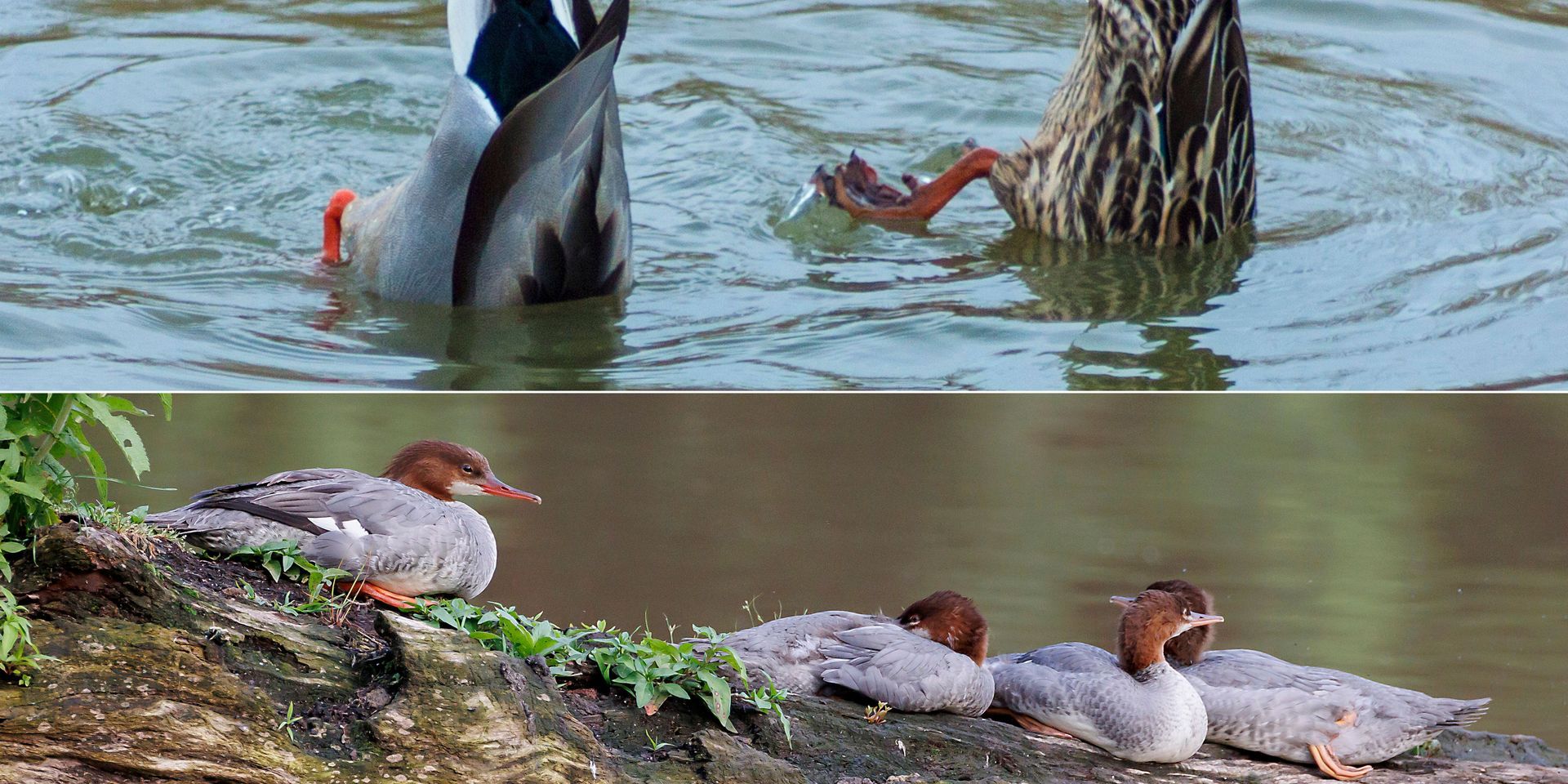
Some ducks tip forward like little feathered seesaws—tails up, heads down—looking almost comical as they “stand on their heads.” Others disappear entirely, slipping underwater and reappearing yards away like they’ve got secret trap doors.
Those are the two big duck feeding guilds you’ll see at PVNC: dabbling ducks and diving ducks. Once you learn the difference, the lake becomes a living field guide—and every flock turns into a fun ID puzzle.
The quick idea
- Dabbling ducks feed mostly at the surface or in shallow water by tipping up to reach plants and small critters.
- Diving ducks feed by fully submerging and swimming underwater to chase food deeper down.
That’s the headline—but the cool part is how their bodies are built for these different lifestyles.
Dabbling ducks: the “shallows shoppers”
What they do
Dabblers feed in shallow water, marsh edges, and flooded vegetation. You’ll often see them:
- Dabbling at the surface (filtering, nibbling, skimming)
- Tipping up (tail straight up, head down)
- Grazing on land like little lawnmowers (yep—some ducks do that!)
What they eat
A lot of a dabbler’s menu comes from the “edge zone”:
- Aquatic plants and seeds
- Algae
- Insects and larvae
- Small snails and invertebrates
How to spot them at PVNC
Look for these clues:
- They sit high on the water (more buoyant, less “sunk in”)
- They take off almost straight up with a quick burst of wingbeats (great for surprise escapes)
- They’re often closer to shore or near emergent vegetation
Common dabblers you might see at Peace Valley
Depending on season and migration, keep an eye out for dabblers such as:
- Mallard (Anas platyrhynchos)
- American Black Duck (Anas rubripes)
- Wood Duck (Aix sponsa)
- Gadwall (Mareca strepera)
- American Wigeon (Mareca americana)
- Green-winged Teal (Anas carolinensis) small, quick, often in tight groups
If you’re watching a duck tip up with its tail in the air, you’re almost certainly looking at a dabbler.
Diving Ducks: the “Underwater Hunters”
What they do
Divers feed by going under—sometimes for surprisingly long stretches—then resurfacing with a shake, a splash, and a look that says, “You didn’t see that.”
They’ll:
- Submerge completely
- Swim underwater using powerful feet like paddles
- Pop up a distance away (often in a different “lane” than where they went down)
- What they eat
Divers tend to target deeper-water foods:
- Mussels and aquatic snails
- Insects and larvae
- Crustaceans
- Aquatic vegetation (some species)
- Fish (especially mergansers)
How to spot them at PVNC
Diving ducks often show these tells:
- They sit lower in the water (heavier-bodied, built to sink and propel)
- They need a running start to take off, pattering along the surface before lift-off
- They’re often farther from shore, congregating over deeper areas of the lake
Common divers you might see at Peace Valley
Divers vary by season, but possibilities include:
- Ring-necked Duck (Aythya collaris)
- Lesser Scaup (Aythya affinis)
- Bufflehead (Bucephala albeola)
- Common Merganser Mergus merganser)
- Hooded Merganser (Lophodytes cucullatus) a diver that specializes more in fish
If a duck disappears underwater like it’s hitting a mute button on reality, it’s probably a diver.
Built different: why their bodies give them away
Here’s the neat interpretive “why” behind what you’re seeing:
- Dabblers are designed for maneuvering and quick escapes
- More buoyant body posture (they “float higher”)
- Feet set more toward the middle of the body, which makes walking easier and takeoff quicker
- Broad bills in many species, good for filtering and grazing
- Divers are designed for underwater propulsion
- Feet set farther back (great for swimming, clumsy for walking)
- Denser bodies and different feather structure that helps them sink and stay submerged
- Often narrower, more specialized bills for grabbing prey underwater (especially mergansers)
So the next time you watch a duck struggle to waddle on shore, you might be watching a diver doing its least favorite activity: walking.
A simple “Peace Valley field test”
Next time you’re at the lake, try this quick three-step ID game:
- Where is it feeding?
Shoreline/shallow edge = likely dabbler
Open/deeper water = likely diver
2. What’s the feeding move?
Tipping up, tail up = dabbler
Full vanish underwater = diver
3. How does it take off?
Pops up and launches quickly = dabbler
Runs across the water first = diver
Do this a few times and you’ll start predicting what a duck will do before it does it—which is half the fun.
A moment to notice: the lake as a layered habitat
Peace Valley Nature Center is a perfect place to learn this because Lake Galena offers multiple “food neighborhoods”:
- Shallow edges with plants, seeds, and insects
- Deeper water with mollusks, larvae, and fish
- Quiet coves and sheltered areas for resting and preening
Dabblers and divers aren’t just different kinds of ducks—they’re different solutions to the same challenge: how to make a living on a lake.
Try this on your next walk
If you want to turn your next visit into a mini-nature activity, bring binoculars and try a “duck behavior checklist”:
- Count how many times a diver submerges in five minutes
- Watch how far it resurfaces from where it went down
- Look for dabblers tipping up and note what habitat edge they’re using
Bonus: listen—some dabblers are surprisingly chatty compared to many divers